
Worrying about Worry

No matter how dark the night, or bleak the news…

No matter how difficult the trial, or long the test…

No matter how unfair it seems, or how much it hurts…

Just don’t worry!

Though you’re toiling the same soil, yet the fig tree has no bud…

Though you’ve prayed and prayed some more, no answer is in sight…

Though you’ve loved, said a kind word, but a slap returns instead…

Just don’t worry!

Whether your anxiety is real or anticipated,

your fear happening or imagined in your mind…

Whether uncertainty has drained your spirit,

blown your smile away with the wind…

Even here, just don’t worry!

Why? Philippians 4:6-7

“Do not be anxious about anything, but in every situation, by prayer and petition, with thanksgiving, present your requests to God.  And the peace of God, which transcends all understanding, will guard your hearts and your minds in Christ Jesus.”

A worrier? Don’t worry. Make your request.

Be blessed until next time! 🙂

Celebrating African American Author & Film Producer, Oscar Devereaux Micheaux

A celebration of Black History, honoring African American author and film producer, Oscar Deveraux Micheaux, prominent sound and silent filmmaker during the 20th Century.

As an African American amateur writer, blogger, aspiring author, and lover of all things about theatre and film, on this last calendar day of Black History Month–a month where Black Americans focus our attention on the significant contributions made by past and present Black Americans to the United States, I chose to honor the life of Mr. Oscar Deveraux Micheaux in this month’s blog.

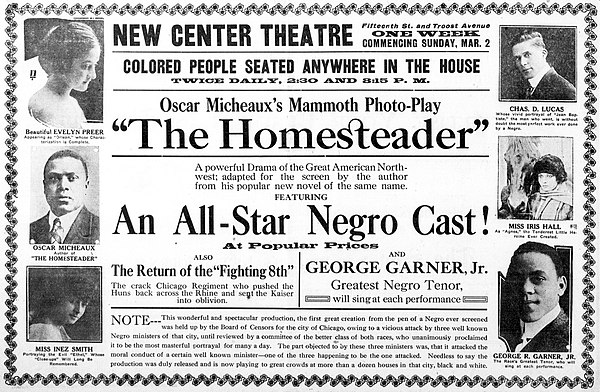
During a time when Black people faced various struggles in the Hollywood film industry (oftentimes excluded), Oscar Micheaux made significant accomplishments for the African American community as a writer, film producer, director, and entrepreneur. “[He] is regarded as the first major African-American feature filmmaker, a prominent producer of race films, and has been described as ‘the most successful African American filmmaker of the first half of the 20th century,’ [producing both silent and sound films.]”[1]

In his book, Slow Fade to Black: The Negro in American Film, 1900-1942, Thomas Cripps (1993) states, “Most early Negro appearances in film followed the Southern stereotypes of the wretched freeman, the comic Negro, the black brute, the tragic mulatto, in keeping with literary and theatrical tradition…to understand the history of Afro-Americans in the history of the cinema is to see a race in tension with white supremacy, in conflict with itself and its own ideals, in a quest to overcome disabilities, and moving slowly toward a viable cinema identity and an honest contribution to Hollywood movies. These stereotypes…were prevalent in Hollywood films up to 1942.”[2]  It is noteworthy how most of Micheaux’s novels and films centered around the social oppression of Black people during this time. Hollywood was not equipped or interested in producing films for African Americans, so, independently, Oscar worked outside of Hollywood and against it, producing over forty-four films–both sound and silent. His first film, The Homesteader, was produced in 1919, and his last, The Betrayal, in 1948. He also has seven novels to his credit. “[His] life and career can be divided into three phases: his years as homesteader and novelist (1910-1917); his years making silent films (1918-1930); and his years as a maker of sound films and as a novelist (1931-1948).”[3]

DJ Spooky, a.k.a. Paul D. Miller, continues by informing us how “…there was generally deep segregation in the [film] industry…Black creators [were] largely relegated to the sidelines, and Black performers largely forced to conform to, and thus reinforce, stereotypes in major Hollywood films throughout the 20th century… A genre of films known as Race films became popular. These films featured Black actors and were shown primarily to Black audiences. Many Black filmmakers during this time were able to independently produce and distribute films that focused on the everyday life of what it meant to be Black in America. [They] used this medium to combat stereotypes and set the tone for an independent Black cinema.”[4] This is where Oscar Micheaux would have an impact.

Born in 1884, the 5th child of 13, to Calvin S. and Belle Michaux in Metropolis, IL, Oscar’s father was born a slave in Kentucky… The best schools were available there and Oscar received his basic education. Betti Carol VanEpps-Taylor, (1999) writes in her book, Oscar Micheaux: Dakota Homesteader, Author, Pioneer Film Maker: a Biography, “Micheaux grew up during a transitional period for African Americans. Some of the four million freedmen benefitted from post-Civil War programs, but many struggled with poverty, bigotry, denial of franchise privileges, lack of access to education, and continuing oppression by a sharecropping system that replaced a legacy of slavery. [Most] looked to a small group of leaders for guidance and inspiration, and Booker T. Washington was the most influential African American at that time…He was the epitome of success, had risen from poverty and slavery to build a great school, and [became] a power broker and adviser to presidents.”[5] Surely, his mother’s deep religious beliefs and Bible teachings, coupled with the Washingtonian values of success through hard work, thrift, and economic ambition are what helped Oscar Micheaux face, yet overcome the varied challenges he did as he strove to become a prominent Black filmmaker.

As Micheaux grew, his journey took several paths. Discontented with local Black culture, and against his parents’ wishes, in 1901, he moved to Chicago with his brother, where he experienced “the good life.” He rented his own place and began to make and save money. He worked various jobs from the stockyards to the steel mills, [and as a shoeshine boy in a barbershop.]”[5] However, the job that most appealed to him and changed his life was working as a Pullman porter for the Southern Illinois Railways. In this job, he was able to travel and meet many affluent upper-class White people. He enjoyed hearing their stories because it kept him abreast of all the latest happenings. In addition, as his train route took him through the Western states in the U.S, he discovered a liking for it. Micheaux’s worldview expanded, he was able to save money, and eventually, he became a homesteader in South Dakota.

Patrick McGilligan, in his book, Micheaux, The Great and Only: The Life of America’s First Black Filmmaker (2009) concludes, “In his time, [Micheaux] became as famous—and controversial—as anyone in the field of so-called ‘race pictures.’ [He was] a self-made man who lived the American dream [and] boasted a record of undeniable achievement in spite of the obstacles erected against his race… He was the Jackie Robinson of American film. No, a Muhammad Ali decades before his time, a bragging black man running around with a camera and making audacious, artistic films of his own maverick style, at a time when racial inferiority in the United States was custom and law… [Micheaux’s films] were among the first films in history to attack lynching’s, segregated housing, gambling rackets, corrupt preachers, domestic abuse, criminal profiling by police, and all kinds of racial inequities.”[6]

Micheaux founded and was president of the Micheaux Film and Book Company (1920). Some of his films have been found and restored. His 1920 film, Within Our Gates—a race film response to racism–is available for viewing on YouTube or other streaming services. Three novels are available for download on Kindle: The Homesteader, The Conquest, and The Forged Note. There is an Oscar Micheaux Committee website where one can view a list of Micheaux’s novels and films, as well as a list of books written about him. Two of his films have been selected for the National Film Registry by the Library of Congress as being “culturally, historically or aesthetically” significant: Within Our Gates (1920) and Body and Soul (1925). An annual Oscar Micheaux Film and Book Festival is held in Gregory, South Dakota, where they honor the life and films of the African American homesteader and filmmaker.

So, in the spirit of Phil. 2:3 (HCSB), which states, “Do nothing out of rivalry or conceit, but in humility consider others as more important than yourselves,”  I want to thank the Lord for hearing about Oscar Micheaux. I am inspired by his story. His bravery to discover and use his gift at such a time when oppression, suppression, rejection, ridicule, and cruel treatment of Black people was at an all-time high is remarkable. Blacks were only recently freed from slavery, thus not seen as very significant at all. He blazed a trail for other African American actors, writers, and filmmakers. Now, African Americans are prominent on and off the Hollywood screen. We are writing books, and producing and directing films and theatre productions that speak to our experience in America and around the world. I’m excited to understand, as Micheaux did, that I can effect change through the written word. Against any odds, I can complete my first book, and, possibly, who knows, the film or play that’s been on my heart. You can too!

Americans, be inspired, you’ve made, and are making significant strides in race relations. African Americans, be inspired; while the struggle continues, we’ve made, and are making more headway. Human beings, be inspired because “trouble don’t last aways.” Thanks, Mr. Micheaux!

Be blessed until next time…


References

[1]Retrieved from https://en.wikipedia.org/wiki/Oscar_Micheaux

[2]Cripps, T. (1993). Slow fade to black: The Negro in American film, 1900-1942. Oxford: Oxford University Press. New Yor, NY. (pp. 7, 11).

[3]Bowser, P., Gaines, J, Musser, Eds, C. (2001). Oscar Micheaux & His Circle: African American Filmmaking and Race Cinema of the Silent Era, Indianan University Press, Bloomington, Indiana.

[4]Miller, Paul D. a.k.a D.J. Spooky. (January 2021). Race Films: The Black Film Industry That Told Black Stories in Cinema’s Earliest Days. Retrieved from https://editorial.rottentomatoes.com/article/race-movies/

[5] VanEpps-Taylor, B. C. (1999). Oscar Micheaux, A Biography: Dakota Homesteader, Author, Pioneer Film Maker [May 28, 1999]. Dakota West Books, Rapid City, SD.

[6]McGilligan, P. (2009). Oscar Micheaux: The Great and Only: The Life of America’s First Black Filmmaker. United Kingdom: HarperCollins. pp. 2-3.


Follow Me

Get new content delivered directly to your inbox.

Bearing Our Cross

What di Jesus Christ mean we He said, “Take up your cross?” Did He mean I would die on the cross as He did, or does this mean something else? Let’s find out what Jesus meant.

Photo by Pixabay on Pexels.com

During your life’s journey, have you been able to identify a cross Our Father, God, has intended you bear? I understand you are upset, depressed, and distressed about a situation? Under your breath or aloud, you’re still cursing, screaming, and walking around in a huff over a predicament you’re in. But have you ever stopped to consider, this may be a cross Christ is asking you to bear for His glory?

Sometimes, cross-bearing is brief. An illness has landed you a stay in the hospital for surgery or treatment of some kind. For this brief period, you’re in tumultuous pain, stagnant, and unable to work to pay the bills; everything halts. Other times, it’s a similar scenario or personality type you don’t like but continuously encounter. “This again,” you think, “I hate these people!” Lastly, some crosses leave a life-long painful imprint on us, and we carry its scars every day.  No prayer, life activity, or changes we’ve made erases the memory. The Apostle Paul experienced this. It is not identified as a cross but as a thorn that he was given. “I was given a thorn in my flesh, a messenger of Satan, to torment me. Three times I pleaded with the Lord to take it away from me. But he said to me, “My grace is sufficient for you, for my power is made perfect in weakness” (2 Cor. 12:7-9). Paul had scars to live with. He tells us, they were given to keep him from becoming conceited. Hmmm! Do crosses, thorns, and pain help with this human malady?

We find in Matthew 16:21-26 dialogue specifically about cross-bearing. What is it? And, who’s it for? According to this text, those who ascribe to being a Christ-follower must take and bear a cross; it’s a part of being united with Christ and sharing in His suffering. I remember having this discussion with an old friend of mine. He completely rejected this idea. Any notion of suffering was a result of negative thinking on others’ part.  When discussing various unpleasant experiences he faced, I would offer him a cross-bearing perspective to help him try to recognize possibly a lesson God was teaching him or character development He was building in him. His response was always the same, “Look, that was Jesus; I’m not Jesus.”

In our text this month, we find Peter also rejecting such negative ideas about suffering. Jesus foretells His suffering and death to his disciples. The text states, “From that time Jesus began to show his disciples that he must go to Jerusalem and suffer many things from the elders and chief priests and scribes, and be killed, and on the third day be raised. And Peter took him aside and began to rebuke him, saying, “Far be it from you, Lord! This shall never happen to you.”

Doesn’t Peter sound like us? During tough times and in challenging conversations, we tell our loved ones, “Stop being so negative. I rebuke that depressing spirit off you.” Peter was possibly trying to console the Lord, lift Him out of despair, or maybe change His perspective. In a sidebar conversation, I imagine Peter saying, “Come on, Lord, you’re the Messiah. You’re a great man doing all these wonderful things for people. And, we’ve been waiting for you all these years, you finally appear, and now you’re going to tell us this? Look, nothing like this is going to happen to you, especially while I’m here. Trust me!” Society tells us to stop being so negative and focus on the positive. We tell family and friends, “You’ll be fine; don’t worry about it!” Satan is usually the culprit for our negative feelings. Not always so, as we see here. Despite Peter’s well-meaning intentions, he was wrong. Jesus rebukes him. “But he (Jesus) turned and said to Peter, “Get behind me, Satan! You are a hindrance to me. For you are not setting your mind on the things of God, but on the things of man.” Ha! Now, how about that? Peter’s kind words are coming straight from hell, and Jesus recognized this because He knew He had to bear a cross.

I don’t think it is happening this way today in our “name it, claim it” prophetic Christian subculture. We actually are accused of and rebuked for “speaking it into existence.” Have you received one of those “just claim it” words during your Christian journey that did not happen as it was proclaimed? Unfortunately, this ideology is running rampant now. People are disheartening individuals by telling them untruths to appease them.

Jesus’ somber, troublesome news to His followers was necessary and true. The disciples would later see it happened just as He said. Jesus uses this blunder by Peter to drive home a point for them and us. “Then Jesus told his disciples, “If anyone would come after me, let him deny himself and take up his cross and follow me. For whoever would save his life will lose it, but whoever loses his life for my sake will find it. For what will it profit a man if he gains the whole world and forfeits his soul? Or what shall a man give in return for his soul? 

Cross-bearing involves:

  • Conforming to Christ’s image
  • Denying yourself
  • Taking (accepting) the cross while continuously following Him
  • Losing one’s life for Christ’s life
Photo by Pixabay on Pexels.com

Conforming to Christ’s image involves sharing in His suffering too. Cross-bearing will challenge our ideals, worldviews, perspectives, dreams, hopes, and desires. It will involve taking actions, making decisions, and/or expressing views, etc. that are counterintuitive to who we are. As we take up our cross and continue to follow Christ, at some point, any ill feelings, ill will, dislike, anger, resentment, and/or grumbling, complaining, and blaming should end. It’s an exchange Christ has called us to make for Himself. We can, however, choose to reject our cross in order to gain the world.

My fellow believers, from a human perspective, our cross may be difficult, as it was for Jesus Christ. We may want to say at times, “Oh no, not this,” or pray, as Paul did, for a problem to be removed. Don’t, however, discount or not recognize your cross because of erroneous satanic teaching happening in the Church today. Understand that, while bearing a cross, sometimes: it will not be fine. It will hurt. It will be painful. It will drive you to despair. It will cause you to cry. It will involve blood, sweat, and tears.  It will baffle your mind. It will make you sad. It will anger and frustrate you. It will be tiresome. It will cost you a lot of money. It will be risky and make you feel uncomfortable. It may require you to take medication or an infusion. It may mean, let it go. It may mean changing your perspective about a race or culture of people. You may have to embrace, live among, or help those you don’t like. It may be, no, it’s not that one; it’s this one over here. It may be, forgive and stay. It may be, forgive and leave. It may be, marry this one, not that one. It may be, not this career, this one. It may be, give that up. It may be growing up poor. It may be, anoint this one for ministry, not that one. You may lose the job, the contest, the award, the beauty pageant, or the business deal. You may be overlooked, rejected repeatedly, unfriended, lied on, and cheated. However, whatever you discover is your cross, don’t despise it. Pick it up and keep “looking unto Jesus, the author, and finisher of our faith, who for the joy that was set before Him endured the cross, despising the shame, and has sat down at the right hand of the throne of God” (Hebrews 12:2 NKJV).

Happy New Year! 😊

Follow Me

Get new content delivered directly to your inbox.

Thanks Lord

Being thankful is what God wants us to do in every situation we may find ourselves in.

Be thankful in all circumstances, for this is God’s will for you who belong to Christ Jesus.
I Thessalonians 5:18

Thanks in all circumstances God? Everything?

But you don’t understand, this Covid-19 pandemic is out of control and has wreaked havoc in my life. I lost family members I love dearly. The disease has left me now struggling to breathe, even move or walk; I’m tired. Not only this, but I already have a chronic illness, and my loved ones too; we’re sick. Trying to avoid Covid and manage my own and their disease is overwhelming, scary. Can the health system properly handle my illness and the number of Covid cases? Am I going to get Covid and die? Is my chronic illness going to worsen? Will I end up with both? These and other concerns elevate my blood pressure. Ugh! I’m fearful.

Sir, in all due respect, my livelihood is gone–in an instant. I no longer have a business. Financially, I’m strapped. I must start over at 55 years old. The work culture has changed and so has my job. I’ve gone out to work all my life; now I must work from home. I don’t know much about computers, navigating Zoom, or managing my kids around work. Their lives are in upheaval too; one week they’re in school, another week, they’re doing virtual learning because someone became sick with Covid. They’re not learning much, and their new schedule collides with mine. I don’t like this. I’m confused.

Do you see, my family has been torn apart. My husband left me. My wife has changed how she now sees me. My kids don’t even visit. I’m lonely.

I find no solace when tuning to media outlets to hear the news so that I stay abreast of what’s going on or discover what I’m supposed to be doing. In fact, I’m even more disheartened. I find myself often gasping for breaths listening to the “breaking news.” It’s sure that, isn’t it? My heart breaks reading the headlines or watching those appalling crime videos they show over and over again–another murder, mass casualty incident, missing person/rape, shooting, or a corruption case involving those in high places. I’m not so thankful to know at any place or at any time, I too could become a victim, simply while working on my job, walking my dog in the park, attending a concert, or church or school, or traveling in my car or on a plane or train. Announcements of racist and social biases and extremist groups and their ideologies run rampant in news coverage. Political leaders are not unified. They’re bashing one another. We’re told about the “left,” the “right,” the “progressives?” What is all this? What does it mean? So much divisiveness. It’s chaotic out there. I have no peace.

I’m a sociable, outgoing person. I always enjoyed freely mingling with friends, dining out, working out at the gym, hosting home parties, or catching a movie at the local theatre. Now I feel trapped in a shell, limited by what I can do, and paranoid to freely venture out to enjoy myself. I’m anxious about what I touch, who comes near me, who’s not vaccinated, and whether the restaurant has been disinfected. Wearing these masks is becoming a nuisance. I’m not free to be me. I want things to be like they were before. I miss socializing. I’m depressed.

So, Lord, are you saying in this verse, I should be thankful because these troubling things are Your will for me? Or, are you saying that what Your will is for those who follow Christ is to say “Thank you Lord” regardless of what is personally happening in their life or in the world around them?

Well, it’s reiterated in Ephesians 5:20, “…always giving thanks to God the Father for everything in the name of our Lord Jesus Christ.” Everything means everything. Always means always. Hmm!

Happy Thanksgiving folks! Be blessed until next time…

Follow Me

Get new content delivered directly to your inbox.
God’s Message by The Holy Spirit

The Holy Spirit’s Role in Interpreting the Scriptures

The Holy Spirit is probably the most misunderstood and overlooked of the Trinity. However, He performs several essential functions. God introduced Him in Acts 1:8 as One with power who would help the apostles witness for Him. At Pentecost, He came astoundingly as told, and the men spoke in each other’s native languages and miraculously understood each other. In her article, The Unsettling Holy Spirit, Dr. Judy Siker discusses the astonishment the Holy Spirit’s presence created. Instead of an entrance that made the men feel comfortable, the Holy Spirit’s presence shook the place and transformed the entire atmosphere and the men in it (Siker, J., 2004). This is indicative of who the Holy Spirit is. He’s the One who inspired biblical authors of old to record God’s message for humankind.  Not only did the Holy Spirit inspire the writing of the Bible, but today he also interprets it for us.  As interpreter, the Holy Spirit challenges our presuppositions, manifests God’s truth to us, enables us to understand what God is saying, and then empowers us to live according to it.

Photo by Andrea Piacquadio on Pexels.com

The Holy Spirit works in the Church through illumination. We’re able to know emphatically God’s word is divinely inspired. And, He tells us what God means. Can you recall times, if ever, when you read or heard the Bible taught or preached, and suddenly, a light turned on in your mind? No longer did it feel as if you were reading a fairy tale story. A sense of reality hit you like a thunderbolt. “This is true,” you suddenly realized! You had read or heard that scripture passage over and over for years, but you could never quite grasp its full meaning. It didn’t penetrate your spirit. You tried meditating on it, but nothing. This happened to me with the verse, “For it is God which worketh in you both to will and to do of his good pleasure” found in Philippians 2:13 (KJV). It’s one often quoted or preached in church and discussed among Christian friends. For me, as often as I had read this verse, it never clicked inside me what God meant. Not until one day, while reading it, the Holy Spirit came and illuminated my mind. When the Holy Spirit works in illumination, it’s like He’s turning on a light. Your surprised! Stunned! It’s an OMG moment, where your eyes are instantly opened, and you can see! The Holy Spirit helped me understand how transformation into Christ’s image is a work God does. This scripture means the Lord works in us to even want to do His will and works in us to do it. I was one of those persons on a treadmill walk to successful Christian living (with many peaks and valleys and highs and lows, may I add). I approached my Christian walk the same as I did my job. Be on time, work hard, strive to be good at it, and toil long hours, if necessary, to get the job done. I was going to get this thing right. It was remarkable when the Holy Spirit explained this verse to me. I found so much freedom and relief from the stress I was under trying to live God’s life through my own efforts.  Contrary to some popular church teachings and beliefs today, the Christian life is living the life of God–one we know nothing about. We’re humans, with a sin nature, and a proclivity for sin. God knows this about us. It’s why the Holy Spirit must come alongside us and enlighten us in God’s word and work in us a desire to do God’s will and live for His good pleasure. It’s not in my nature to want to do this. This is what our great Father–God, the Holy Spirit–is all about. It’s why, since Pentecost, He has continuously been helping guide believers and non-believers to understand the truth about Himself (John 14:6 NIV).  

God, the Father, God the Son, and God the Holy Spirit—the Trinity. They work in accord and each function in one purpose. Scripture tells how God, the Son–Jesus Christ–always did what pleased the Father (John 8:29 NIV). It makes sense then how it’s only through the Holy Spirit’s work in illumination that we gain a proper understanding of scripture, which helps us become like Christ. He only acts in accord with what is written in God’s word. His interpretation will be consistent in revealing what is written about God’s nature, His ways, and what pleases Him. The Holy Spirit will not alter the written word to appease our lifestyles or desires, to make us feel comfortable, or to make us be right. People do that. At the same time, however, The Holy Spirit does not do all the work for us in interpreting God’s word. “The Lord expects us to use the available Bible tools to discover God’s message” (Duvall & Hays. 2012, pp.229-230). Second Timothy 2:15 (NIV) supports this idea, where it states, “Study to shew thyself approved unto God…”

“So then faith cometh by hearing, and hearing by the word of God,” Romans 12:17 tells us. By hearing God’s word, we become convinced about what God has said. Next, it takes root in our hearts and becomes our way of being and thinking. Finally, as we go about our daily life activities and encounter various type situations and people, we then do (or put into practice) what the Holy Spirit has made known to us. How do you know this to be true, you may ask? Well, in John 14:26, when Jesus was preparing His disciples for His departure, He told them, “But the Advocate, the Holy Spirit, whom the Father will send in My name, will teach you all things and will remind you of everything I have told you.” An advocate speaks up boldly to defend someone’s cause. We can rely on the Holy Spirit to come alongside us in our situations in life to boldly speak for God, reminding us of what He said and strengthening us to carry it out. He’ll be championing us on–assuring us “we can do all things through Christ.” I don’t know about you, but this is inspiring for me to know we have a Holy Spirit who equips and prepares us for all things that pertain to life and godliness.

Put a praise on it with me for Our God, The Holy Spirit! Inspiration by Ellie does not own the rights to this song.

So, in closing, I admonish you today to continue reading, studying, and meditating on God’s word, even when it makes no sense to you at all. Don’t become discouraged or disappointed because you’re not “getting it” and put it down, because you don’t know at which time you’re reading or listening to God’s word, when the Holy Spirit is going to show up to shake your world and change your life by turning the lights on to what God’s message is to you. If anyone is reading this who has never pursued the life of God or read the Bible, you can start today. Try it! Begin reading God’s words in the Bible today and watch! 😊

Be blessed until next time.


References

Duvall, J.S., & Hays, J.D. (2012). Grasping God’s Word. Zondervan. Grand Rapids, MI.

Siker, J. Y. (2004). The Unsettling Holy Spirit. The Living Pulpit (Online)19.

Follow Me

Get new content delivered directly to your inbox.