Hello Friends,
Faithful is he that calleth you, who also will do it.
(1 Thessalonians 5:24 KJV)
*****
Pre-order information will be posted soon!

Be blessed until next time!
Ellie

Hello Friends,
Faithful is he that calleth you, who also will do it.
(1 Thessalonians 5:24 KJV)
*****
Pre-order information will be posted soon!
Be blessed until next time!
Ellie
Hey guys. Here is a flyer announcing my upcoming book. The finished cover is coming in early January. I pushed the release date back to the 25th of January.
Have a happy, blessed, Merry Christmas! 😊❤️🎄

Click to send your name and email to be added to my author’s list once published.
Be blessed until next time. Luv you!
Ellie

Hello friends. I unexpectedly lost my 3rd eldest sister last week; she was one of my beta readers for my upcoming book. As a university professor, she would read my manuscript, critique and edit it, and provide feedback. Her feedback, I know, will enhance the book, scheduled to be published in 2025 (Lord willing). Here’s another excerpt.
Excerpt:
“What good is a relationship where neither person is taking steps to strengthen the bond to know each other better? I didn’t find this out until much later in life; I was in such relationships, where it seemed I was putting the most in. I’m naturally an initiator, a friendly person—asking questions to know more, conversational, making suggestions, or giving advice. A lot of times, friends or associates did not always take my suggestions or want to do what I liked doing, so I learned to do it alone. My mom taught me this—learn how to entertain or enjoy yourself. It’s not that I was so weird, or maybe I was. I don’t know. It’s just that the things that excited me did not particularly excite the people I was hanging out with. Maybe, wrong friends, you think? Possibly.
Nonetheless, relationships require cultivating—taking a walk in the park or dining together, binge-watching a TV series or working out at a gym, communicating with one another, and probing them to gain a deeper knowledge or understanding. Time together enables us to see one another and learn each other’s ways. If we don’t cultivate a relationship—new or old—what’s the use? Why are we in it? The relationship will ultimately become a stalemate. It’s going nowhere. Both of you will remain in the same state, the same place, where nothing new is happening, and there is no growth. You’ll just exist. I always believed relationships, especially a love relationship, should bring out the best in you.
Well, this idea is true in a new relationship with God the Father, through His Son Jesus Christ–the relationship needs cultivating for it to grow.”
[Copyright © 2024 by Eleanor D. Parks]
Want to read more? Click here to add your name and email to my author’s list to be notified once the book goes to print.
Remain blessed until next time! 🙂
Take a look at Inspiration by Ellie’s 2023 year in review of Blog messages, written to uplift, inspire, include, and point you to a wonderful life with God, the Father through His Son, Jesus Christ!
Well, we’re at the close of 2023. My year is ending severely congested with flu-like symptoms since Christmas day, (but not COVID or the flu the doctor says). I’ve been bed-bound in my pjs and loungewear, taking meds, and drinking lots of juices. It’s not so bad, however, because I’m completing some Bible studies I started, reviewing videos from a writer’s conference I attended, catching up on some reading, and reflecting on my writing. I don’t just write to pass the time or because I like to. I write with a message I share with my readers to inspire them. This is the reason for Inspiration by Ellie’s blog site, as noted on my page titled Where can I find Inspiration.
I closed 2022 with a reminder for us to take into 2023. The blog was An Unprecedented Gift of Jesus Christ. Presented to us by God, the Father, Matthew’s gospel tells us the Messiah will be called “Jesus, who will save his people from their sins,” and “Immanuel,” which means “God with us.” Long before Jesus was to arrive on earth, the Israelite community foretold his coming. The gift of Jesus Christ was unprecedented because of the way Jesus was conceived, the angelic appearances made about Him, and the array of people God strategically used to help get Him here. From Jesus’ conception to His birth to speaking his first sermon and performing His first miracle, God called on people to participate in this miracle. This demonstrates God’s willingness to relate with us. It’s also why Christmas is such a memorable time in the Christian community! But our commemoration does not end when the Christmas season does. As Immanuel, Jesus Christ was on a mission–to show us God and bring us to Him. Jesus Christ’s life, death, and resurrection resulted in us being rescued from sin’s dominion, sin’s power, sin’s penalty, and–soon—from sin’s very presence. The completion of His earthly mission fulfilled all of God’s righteous requirements or standards He had in place to be in a right standing with Himself. Our acceptance and belief in this truth about Jesus is how we become close to God; Jesus is the only way we can do so. It’s why He’s important to get to know. And this is why each month in every year, I write blogs—to communicate this truth in such a way you get it!
So, did I do that? Have I inspired or encouraged you through my Blog posts? Do you feel God’s love and concern for you? Have you learned something important from the scriptures? Did you gain any hope to live and fight another day? Did you discover something new, a different perspective? Were you uplifted or encouraged this year? Were you incited to believe Jesus’ testimony and invite Him into your heart as your Lord and Savior? Could you get a sense of how well-known and important you are to God from the explanation of scripture, and how important God and His Son, Jesus, is to the world?
I’m closing 2023 by recapping Inspiration by Ellie’s 2023 blog posts. Welcome to all my new subscribers who came on board this year! Thank you to all who have been following me for a while; I appreciate all of you and welcome your comments, suggestions, thoughts, or criticisms. Feel free. If you haven’t read any one post, simply click the link to a title that may interest you. You can also complete the Subscribe section to automatically receive monthly content each time I post. Finally, join my author’s mailing list to be notified about my upcoming book to be published in 2024.
Inspiration by Ellie’s 2023 Blog Messages:
January – He’s Got the Whole World in His Hands.
The gist or main point here: From the verse in the Bible in 1 Chron 29:11-13, to emphasize God’s superiority, greatness, power, and ownership over everything and everyone in our world.
The gist or main point here: Shared a personal experience of my life for you to know me better, which is an excerpt from my upcoming book.
March – Find Shelter
The gist or main point here: Local, state, national, and world news headlines and social media are overwhelming most days. From Psalms 91, persons can find comfort that there is a safe place and shelter one can find in God.
The gist or main point here: “God is good all the time, and all the time God is good” is a popular cliché we hear and say a lot today. But it’s true! It’s God’s nature to only be good and show goodness. Acts 10:38
May – Repost of Find Shelter
The gist or main point here: This is a repost of March’s blog, Find Shelter. I reposted due to the continuous disturbing news I was hearing.
The gist or main point here: Jesus made many controversial statements, ones His followers could not always comprehend. This blog is an exposition of what Jesus was teaching His followers in John 15:18-21 about being in this world but not of the world.
The gist or main point here: This blog is a continued exposition of Jesus’ statement about His followers being in the world but not of the world. This time, we also expound on the scripture found in John 17:13-23, where Jesus is clear how this idea was not just for His followers during His time but all who would come after them.
The gist or main point here: This is a daily devotional entitled, “Not of the World” by Sheri Rose Shepherd (2015), His Princess Every Day Devotional, Bible Gateway. I follow His Princess Every Day Devotionals and enjoy Sheri’s messages. This one coincides with mine about not being of the world.
The gist or main point here: Discussion on a story in the Bible found in Luke 8:43-48 about a woman who had an issue of blood for twelve years; Jesus healed her because of the faith she demonstrated. We too can be healed of our issues.
The gist or main point here: Reflections on the Thanksgiving holiday and specific things for which I was personally grateful.
**********

Inspiration by Ellie Blog family!
I love you and wish you God’s choicest blessings!
I hope to connect with you in better ways and more in 2024!
A celebration of Black History, honoring African American author and film producer, Oscar Deveraux Micheaux, prominent sound and silent filmmaker during the 20th Century.

As an African American amateur writer, blogger, aspiring author, and lover of all things about theatre and film, on this last calendar day of Black History Month–a month where Black Americans focus our attention on the significant contributions made by past and present Black Americans to the United States, I chose to honor the life of Mr. Oscar Deveraux Micheaux in this month’s blog.
During a time when Black people faced various struggles in the Hollywood film industry (oftentimes excluded), Oscar Micheaux made significant accomplishments for the African American community as a writer, film producer, director, and entrepreneur. “[He] is regarded as the first major African-American feature filmmaker, a prominent producer of race films, and has been described as ‘the most successful African American filmmaker of the first half of the 20th century,’ [producing both silent and sound films.]”[1]
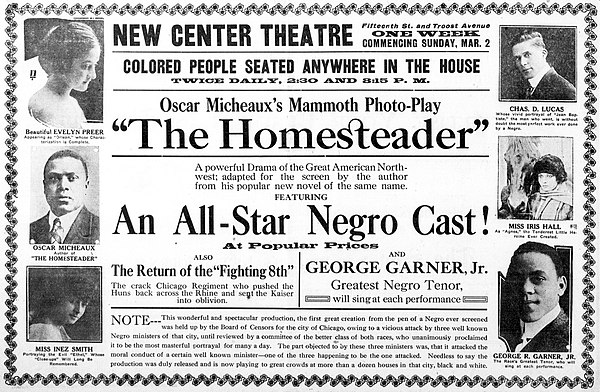
In his book, Slow Fade to Black: The Negro in American Film, 1900-1942, Thomas Cripps (1993) states, “Most early Negro appearances in film followed the Southern stereotypes of the wretched freeman, the comic Negro, the black brute, the tragic mulatto, in keeping with literary and theatrical tradition…to understand the history of Afro-Americans in the history of the cinema is to see a race in tension with white supremacy, in conflict with itself and its own ideals, in a quest to overcome disabilities, and moving slowly toward a viable cinema identity and an honest contribution to Hollywood movies. These stereotypes…were prevalent in Hollywood films up to 1942.”[2] It is noteworthy how most of Micheaux’s novels and films centered around the social oppression of Black people during this time. Hollywood was not equipped or interested in producing films for African Americans, so, independently, Oscar worked outside of Hollywood and against it, producing over forty-four films–both sound and silent. His first film, The Homesteader, was produced in 1919, and his last, The Betrayal, in 1948. He also has seven novels to his credit. “[His] life and career can be divided into three phases: his years as homesteader and novelist (1910-1917); his years making silent films (1918-1930); and his years as a maker of sound films and as a novelist (1931-1948).”[3]
DJ Spooky, a.k.a. Paul D. Miller, continues by informing us how “…there was generally deep segregation in the [film] industry…Black creators [were] largely relegated to the sidelines, and Black performers largely forced to conform to, and thus reinforce, stereotypes in major Hollywood films throughout the 20th century… A genre of films known as Race films became popular. These films featured Black actors and were shown primarily to Black audiences. Many Black filmmakers during this time were able to independently produce and distribute films that focused on the everyday life of what it meant to be Black in America. [They] used this medium to combat stereotypes and set the tone for an independent Black cinema.”[4] This is where Oscar Micheaux would have an impact.
Born in 1884, the 5th child of 13, to Calvin S. and Belle Michaux in Metropolis, IL, Oscar’s father was born a slave in Kentucky… The best schools were available there and Oscar received his basic education. Betti Carol VanEpps-Taylor, (1999) writes in her book, Oscar Micheaux: Dakota Homesteader, Author, Pioneer Film Maker: a Biography, “Micheaux grew up during a transitional period for African Americans. Some of the four million freedmen benefitted from post-Civil War programs, but many struggled with poverty, bigotry, denial of franchise privileges, lack of access to education, and continuing oppression by a sharecropping system that replaced a legacy of slavery. [Most] looked to a small group of leaders for guidance and inspiration, and Booker T. Washington was the most influential African American at that time…He was the epitome of success, had risen from poverty and slavery to build a great school, and [became] a power broker and adviser to presidents.”[5] Surely, his mother’s deep religious beliefs and Bible teachings, coupled with the Washingtonian values of success through hard work, thrift, and economic ambition are what helped Oscar Micheaux face, yet overcome the varied challenges he did as he strove to become a prominent Black filmmaker.
As Micheaux grew, his journey took several paths. Discontented with local Black culture, and against his parents’ wishes, in 1901, he moved to Chicago with his brother, where he experienced “the good life.” He rented his own place and began to make and save money. He worked various jobs from the stockyards to the steel mills, [and as a shoeshine boy in a barbershop.]”[5] However, the job that most appealed to him and changed his life was working as a Pullman porter for the Southern Illinois Railways. In this job, he was able to travel and meet many affluent upper-class White people. He enjoyed hearing their stories because it kept him abreast of all the latest happenings. In addition, as his train route took him through the Western states in the U.S, he discovered a liking for it. Micheaux’s worldview expanded, he was able to save money, and eventually, he became a homesteader in South Dakota.
Patrick McGilligan, in his book, Micheaux, The Great and Only: The Life of America’s First Black Filmmaker (2009) concludes, “In his time, [Micheaux] became as famous—and controversial—as anyone in the field of so-called ‘race pictures.’ [He was] a self-made man who lived the American dream [and] boasted a record of undeniable achievement in spite of the obstacles erected against his race… He was the Jackie Robinson of American film. No, a Muhammad Ali decades before his time, a bragging black man running around with a camera and making audacious, artistic films of his own maverick style, at a time when racial inferiority in the United States was custom and law… [Micheaux’s films] were among the first films in history to attack lynching’s, segregated housing, gambling rackets, corrupt preachers, domestic abuse, criminal profiling by police, and all kinds of racial inequities.”[6]
Micheaux founded and was president of the Micheaux Film and Book Company (1920). Some of his films have been found and restored. His 1920 film, Within Our Gates—a race film response to racism–is available for viewing on YouTube or other streaming services. Three novels are available for download on Kindle: The Homesteader, The Conquest, and The Forged Note. There is an Oscar Micheaux Committee website where one can view a list of Micheaux’s novels and films, as well as a list of books written about him. Two of his films have been selected for the National Film Registry by the Library of Congress as being “culturally, historically or aesthetically” significant: Within Our Gates (1920) and Body and Soul (1925). An annual Oscar Micheaux Film and Book Festival is held in Gregory, South Dakota, where they honor the life and films of the African American homesteader and filmmaker.
So, in the spirit of Phil. 2:3 (HCSB), which states, “Do nothing out of rivalry or conceit, but in humility consider others as more important than yourselves,” I want to thank the Lord for hearing about Oscar Micheaux. I am inspired by his story. His bravery to discover and use his gift at such a time when oppression, suppression, rejection, ridicule, and cruel treatment of Black people was at an all-time high is remarkable. Blacks were only recently freed from slavery, thus not seen as very significant at all. He blazed a trail for other African American actors, writers, and filmmakers. Now, African Americans are prominent on and off the Hollywood screen. We are writing books, and producing and directing films and theatre productions that speak to our experience in America and around the world. I’m excited to understand, as Micheaux did, that I can effect change through the written word. Against any odds, I can complete my first book, and, possibly, who knows, the film or play that’s been on my heart. You can too!
Americans, be inspired, you’ve made, and are making significant strides in race relations. African Americans, be inspired; while the struggle continues, we’ve made, and are making more headway. Human beings, be inspired because “trouble don’t last aways.” Thanks, Mr. Micheaux!
Be blessed until next time…
References
[1]Retrieved from https://en.wikipedia.org/wiki/Oscar_Micheaux
[2]Cripps, T. (1993). Slow fade to black: The Negro in American film, 1900-1942. Oxford: Oxford University Press. New Yor, NY. (pp. 7, 11).
[3]Bowser, P., Gaines, J, Musser, Eds, C. (2001). Oscar Micheaux & His Circle: African American Filmmaking and Race Cinema of the Silent Era, Indianan University Press, Bloomington, Indiana.
[4]Miller, Paul D. a.k.a D.J. Spooky. (January 2021). Race Films: The Black Film Industry That Told Black Stories in Cinema’s Earliest Days. Retrieved from https://editorial.rottentomatoes.com/article/race-movies/
[5] VanEpps-Taylor, B. C. (1999). Oscar Micheaux, A Biography: Dakota Homesteader, Author, Pioneer Film Maker [May 28, 1999]. Dakota West Books, Rapid City, SD.
[6]McGilligan, P. (2009). Oscar Micheaux: The Great and Only: The Life of America’s First Black Filmmaker. United Kingdom: HarperCollins. pp. 2-3.
Get new content delivered directly to your inbox.
 Inspiration by Ellie